

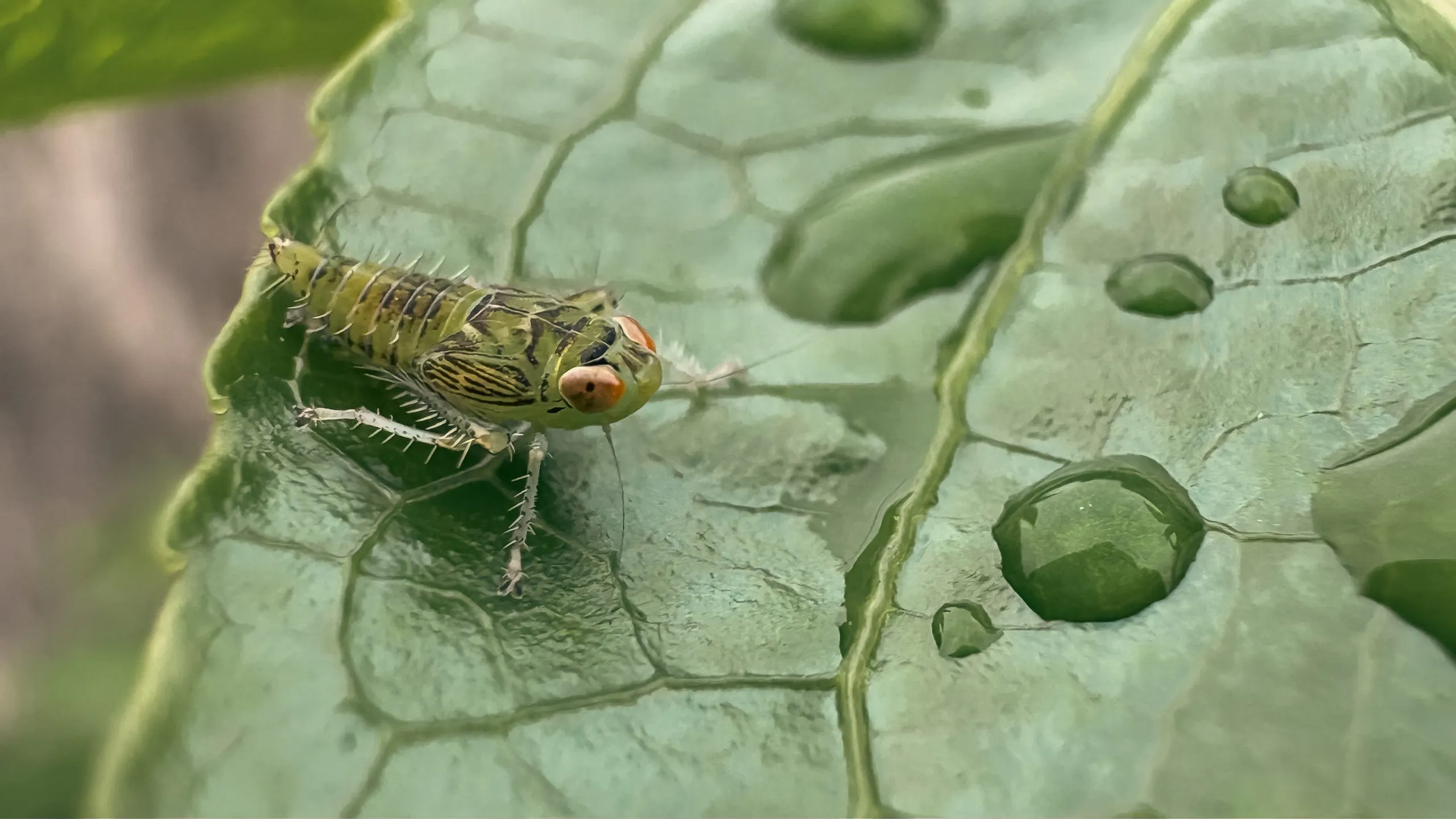
One morning I found a leafhopper nymph on a wet leaf. It was smaller than a grain of rice, with red eyes, a striped body and legs lined with tiny spines. I must have walked past that plant a hundred times.
That moment sums up what six months of looking closer has taught me. The interesting stuff was always there. I just wasn’t looking.
I had already been walking at least 3 km every day. But it was only when I started paying attention that the walk began to give something back.
More than a daily walk
Looking closer asks me to be present. It means noticing the flowers, insects, textures and sounds I would otherwise pass by. It means getting close enough to smell a flower, touching the bark of a tree or a woolly leaf, and listening for birdsong along the way.
That small shift has turned my walks into more than exercise. They have become a sensory experience: a way to be mindful, to reset, and to leave the office behind where it belongs.
Why it matters when you work from home
Remote work has brought many good things, but for desk workers it has also blurred the line between work and home. When I used to commute, I still saw the world around me, for better or worse. I drove past people’s gardens and watched sunsets while sitting in traffic.
When home and work share the same space, it is easy to slip into an eat, sleep, work, repeat routine. A walk with attention creates a small but meaningful boundary: a chance to reconnect with the world beyond the screen.
And you don’t need to go far. Your own garden, the pavement, or the nearest patch of green can be enough. Local nature has a lot to offer when you give it your attention.
What the research says
My experience is personal, but a growing body of research backs it up.
Noticing nature improves wellbeing. In a trial with 582 adults, people prompted to notice good things in urban nature had bigger wellbeing gains than those prompted to notice buildings. The researchers describe it as the first controlled evidence of its kind. (University of Derby, 2019)
Looking for wonder makes a walk work harder. Older adults who took weekly 15-minute “awe walks” for eight weeks reported more positive emotions and less daily distress than people on ordinary walks. The study was small, but encouraging. (UCSF, 2020)
Birds lift your mood for hours. Seeing or hearing birds was linked to better wellbeing lasting up to about eight hours. The effect held for people with depression, and wasn’t explained by nearby trees or water. (King’s College London, 2022)
Green routes quiet a busy mind. Walking through greenery reduced rumination and activity in a brain region linked to it. Walking beside a busy road did not. If you have the choice, take the leafy street. (Bratman et al., PNAS, 2015)
Local nature counts. People who spent at least 120 minutes a week in nature were more likely to report good health and wellbeing. Most of those visits were within about 3 km of home. (White et al., Scientific Reports, 2019)
An invitation to look closer
Looking closer doesn’t need a grand adventure, expensive gear or hours of free time. It starts with a few minutes outside and a willingness to notice what is already there.
On your next walk, pause for a moment. Look at a leaf, listen for a bird, notice the changing light. You may be surprised by what has been waiting for you all along.
In my next post, I’ll share more about finding wonder close to home, starting with the garden.
Slow down. Look closer.